Learn to Skate

Roller skating lessons, classes, workshops, tutorials, videos – Membership content

  • Building Your Skating Foundation

    Building on Strong Foundations

    Where Power, Precision, and Confidence Begin

    Every beautiful spin.
    Every confident edge.
    Every soaring jump.

    They all begin in the same place.

    The foundation.

    This Spring Semester at Sk8Arts Academy, our theme is Strong Foundations — and we’re dedicating the coming weeks to reinforcing the essential elements that make everything else possible.

    Because advanced skating isn’t built on tricks.
    It’s built on posture, balance, and core strength.

    And if the foundation is weak, the structure above it will always wobble.


    The Core: Your Skating Power Source

    In artistic roller skating — just like in ballet, gymnastics, or figure skating — the core is not just “abs.”

    It includes:

    • Deep abdominal muscles
    • Lower back stabilizers
    • Pelvic alignment
    • Glutes and hip stabilizers

    Sports science consistently shows that proximal stability (core control) creates distal mobility (controlled arms and legs). In simple terms:

    If the center is stable, the limbs can move with power and precision.

    Without core engagement:

    • Jumps lose height.
    • Spins travel.
    • Edges flatten.
    • Arms flail instead of finishing lines.

    With a strong core:

    • Rotation becomes faster and cleaner.
    • Edges deepen naturally.
    • Free legs extend with control.
    • Power transfers efficiently from the floor through the body.

    The core is the engine.
    Everything else is steering.


    The Weight of the Head: The Hidden Balance Factor

    Here’s something most skaters don’t think about:

    The average human head weighs 10–12 pounds.

    That’s roughly the weight of a bowling ball sitting on top of your spine.

    If that weight is even slightly forward, backward, or tilted to one side, it shifts the body’s center of mass — and on wheels, that shift is amplified.

    A dropped chin?

    • Pulls the upper body forward.
    • Forces compensations in the hips.
    • Flattens edges.

    A tilted head?

    • Breaks alignment.
    • Disrupts rotation axis in spins.
    • Causes off-centered turns.

    When the head is balanced directly over the spine, something remarkable happens:

    • The body stacks.
    • The core engages naturally.
    • The skater feels lighter.

    Alignment isn’t cosmetic.
    It’s mechanical.


    Posture: The Architecture of Skating

    Posture in skating is not stiff.
    It is dynamic alignment.

    Imagine building a cathedral. If the base is crooked, no amount of decoration will fix the structure. Skating is the same.

    Correct posture:

    • Allows power to transfer from the floor through the legs.
    • Keeps the center of gravity over the skating foot.
    • Creates clean lines that judges see immediately.
    • Reduces fatigue and injury.

    Poor posture:

    • Wastes energy.
    • Creates tension in shoulders and neck.
    • Makes skills feel harder than they are.

    When posture is correct, skating feels easier — not because it is easy, but because the body is working efficiently.

    And efficiency is elegance.


    Balance: The Beginning of Mastery

    Balance is not static.
    It is controlled motion.

    In this semester, we’ll revisit:

    • One-foot balance and edge quality
    • Weight placement over the ball of the foot
    • Knee bend and ankle articulation
    • Controlled upper body carriage

    True balance begins in the core and radiates outward.

    When the center is steady:

    • Free legs float instead of swing.
    • Arms finish movements instead of correcting mistakes.
    • Skaters appear calm — even during difficult skills.

    That calm is not magic.
    It’s structure.


    Why We’re Slowing Down to Go Faster

    It may be tempting to rush into higher level dances, advanced choreography or more daring tricks.

    But here’s the truth every champion eventually learns:

    The skater who masters fundamentals progresses faster in the long run.

    Strong foundations:

    • Build confidence.
    • Reduce fear.
    • Improve consistency.
    • Create power that doesn’t rely on force.

    We are not “going backward.”
    We are reinforcing the roots so the tree can grow taller.


    The Bigger Meaning of Strong Foundations

    This theme isn’t only physical.

    It applies to:

    • Discipline in practice.
    • Respect for classical technique.
    • Commitment to details.
    • Pride in doing basics beautifully.

    Because artistic skating is not built on shortcuts.
    It is built on intention.

    And when your foundation is strong, everything else becomes possible.


    This spring, we strengthen from the inside out.

    Core first.
    Posture aligned.
    Head balanced.
    Edges deep.

    Strong Foundations.


    Category: , ,
  • Our March Theme: Strong Foundations

    Building Strong Foundations

    🌿 Strong Foundations

    Where the Love of Skating Begins — and Grows

    What makes someone look at a great skater and think,
    I want to learn how to do that?

    Before edges, before spins, before posture corrections — there is a spark.

    For some, it’s the music.
    For others, it’s the feeling of flying while still on the ground.
    For many, it’s watching someone move with grace and confidence and thinking, that looks like freedom.

    That spark is the very first foundation.

    And foundations matter.


    The Desire to Skate

    Every skater begins in a different place. Some are drawn immediately to the artistry and athleticism. Others simply want to feel steady, confident, and comfortable rolling with friends.

    A strong foundation in skating begins by nurturing that desire — not rushing it.

    When beginners are encouraged instead of overwhelmed, when they are guided instead of left to figure it out alone, they begin to associate skating with growth rather than frustration.

    And that makes all the difference.


    The Role of the Teacher

    A supportive, qualified teacher or coach becomes part of that foundation.

    Great instructors don’t just teach skills — they:

    • Create a safe space to try and fail.
    • Break down complex movements into achievable steps.
    • Model beautiful technique and strong posture.
    • Inspire skaters to see what is possible.

    For some students, that guidance leads to advanced dance, figures, jumps, and team skating.
    For others, it leads to confident recreational skating, fitness, and lifelong enjoyment.

    Both paths are valid.

    A strong teacher helps each skater build the foundation that supports their journey.


    What a Quality Learn-to-Skate Program Brings to a Rink

    A rink with a strong instructional program feels different.

    There is focus.
    There is progress.
    There is community.

    Skaters practicing skills bring energy to the floor. Families see improvement week by week. Friendships form around shared goals. The rink becomes more than a place to roll in circles — it becomes a place to grow.

    Quality instruction strengthens the entire skating community. It builds consistency, commitment, and a culture of learning that benefits everyone on the floor.

    When a rink invests in foundations, it builds resilience — the kind that carries it through changing trends and seasons.


    Foundations Support Flight

    This semester, as we focus on posture, core strength, balance, and alignment, we’re not just revisiting basics.

    We’re reinforcing the structure that supports:

    • Advanced Artistic skating
    • Precision and Performance Teams
    • Jam, Rexing, Rhythm and style skating
    • Speed Skating
    • Confident recreational skating

    Every advanced movement rests on fundamental control.

    Strong posture creates power.
    Core strength creates stability.
    Balance creates freedom.

    When the foundation is solid, skating feels lighter. Stronger. More expressive.


    This spring, we’re building from the inside out.

    Whether your goal is competitive excellence, performance skating, or simply joyful laps around the rink — your foundation matters.

    And when that foundation is strong, everything else can rise.


    Category: , ,
  • Where Do Star Skaters Go After Beginners Class?

    A skater becomes a “star” the moment they try again after falling, the moment they glide a little steadier, the moment they realize they can do more than they thought. But talent needs guidance. Confidence needs structure. So where do star skaters go after beginner’s class? They step into the next level of training — where skill deepens, expression grows, and skating truly begins to shine.

    🌟 New at Sk8Arts Academy: Two Pathways to Confidence on Wheels

    At Sk8Arts Academy, we believe skating should feel joyful, structured, and achievable at every level. Whether a skater is just learning how to balance… or ready to shine with performance energy… we now have two new classes designed to guide them forward with purpose.

    Our progressive system builds strong fundamentals first — because confidence on wheels starts with control.

    Here’s where our newest classes fit into that journey:

    🛼 Sk8Skills 1 & 2

    Wednesdays | 3:30 – 4:30 PM

    The Foundation Class

    Sk8Skills 1 & 2 is where strong skaters are built.

    This class focuses on:

    • Forward rolling & controlled stopping
    • Balance and posture
    • Bubbles and edge awareness
    • Weight transfer & one-foot glides
    • Beginning freestyle and dance skating
    • Fun tricks and partner skating

    We break skills into simple, teachable steps so skaters truly understand what their feet are doing — and why.

    ✨ This class is the entry point into the Sk8Arts Academy system.
    It prepares skaters for specialty tracks like GrooveSk8, ArtisticSk8, and Sk8Stars.

    When basics are strong, everything else becomes easier.

    Sk8Stars

    Thursdays | 4:30 – 5:30 PM

    The Bridge to Performance Class

    Sk8Stars is designed for skaters who are ready to grow beyond basic skills and step into confidence on wheels.

    This class includes:

    • Stronger edge control
    • Introductory turns and transitions
    • Musical timing and rhythm
    • Simple choreography combinations
    • Performance confidence

    Sk8Stars bridges foundational skating and our more advanced ArtisticSk8 levels.

    ✨ In our progressive system, Sk8Stars builds the spark — helping skaters see themselves as performers, not just participants.

    🌈 Where These Classes Fit in the Sk8Arts Academy System

    Our teaching structure is progressive and intentional:

    1. Sk8Skills 1 & 2 – Learn control and confidence
    2. Sk8Stars / GrooveSk8 – Develop style, strength, and musicality
    3. ArtisticSk8 (Bronze, Silver, Gold) – Structured artistic training
    4. Team & Performance Pathways – Test, show and competitive skating

    Each level supports the next.
    Each class builds community.
    Each skater grows at their own pace — with certified, experienced instructors guiding every step.


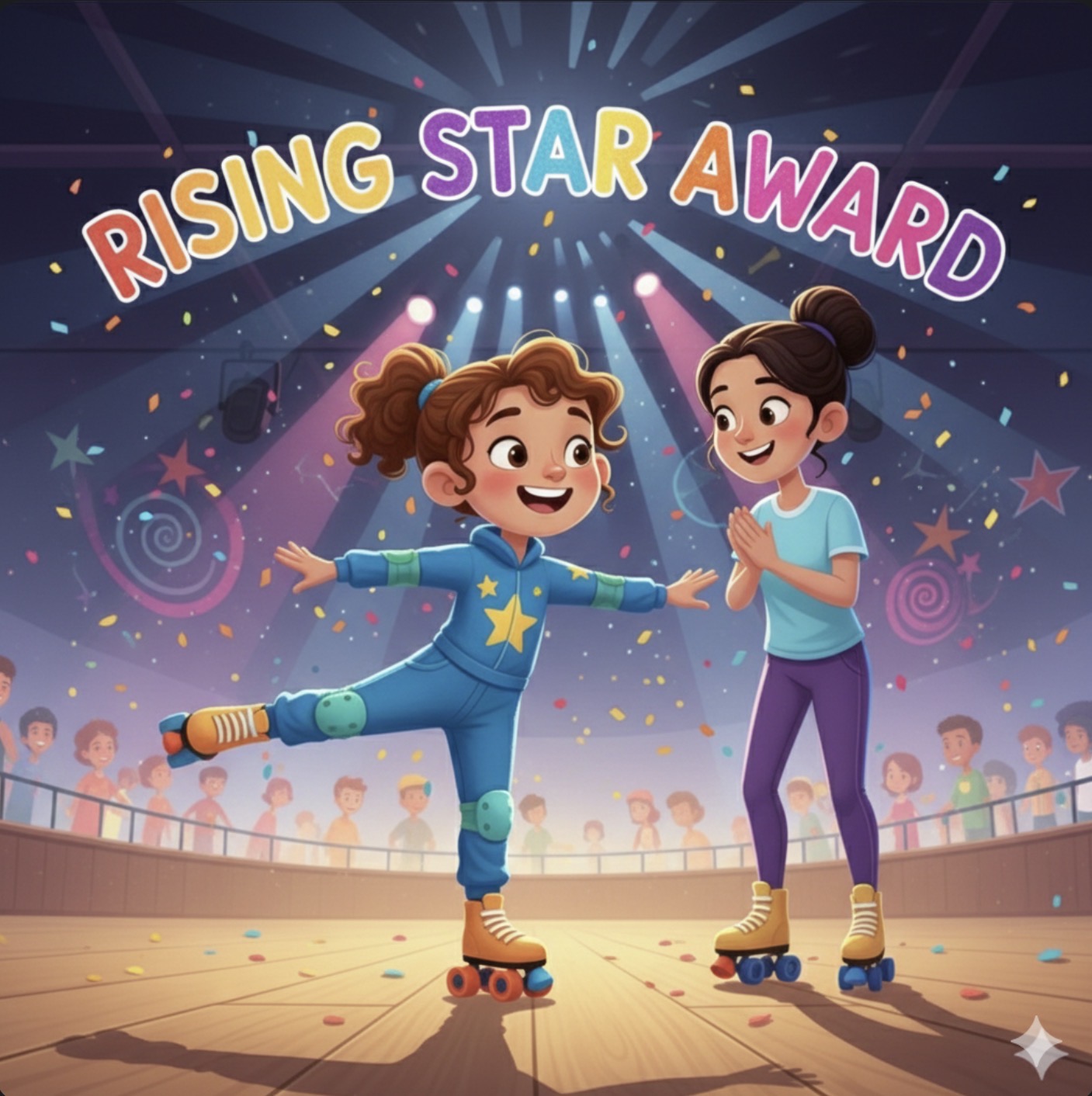
    Rising Star Award

    🎟 Ready to Use Your Award?

    If you or your skater received an award card, we invite you to redeem it for a complimentary class experience.

    Come see what structured skating feels like.

    This offer expires on May 31, 2026.

    Category: , ,
  • To Help or Not to Help: That Is the Skating Question

    But I’m only trying to help!

    As a skating instructor/coach, I see struggling skaters all the time. It’s part of the job. Even when I’m clearly wearing a coach’s jacket, ID badge, or that universal symbol of authority—holding a clipboard—some folks still wave me off with a polite, “Oh, no… I’m good.”
    And you know what? In a public skating setting, I believe them. I smile, introduce myself, and leave them with: “If I can help, just let me know.” Then I skate off into the sunset like a respectful roller skating cowboy.


    Because here’s the thing: knowing how to “read the room”—or more accurately, read the rink—is an essential coaching skill. Not every skater wants help, even if they’re clearly locked in a life-or-death battle with their inside edges. Maybe their friends or family are watching and they’re self-conscious. Maybe they’re just trying to survive their last lap so they can collapse onto the bench with dignity. Or maybe (and this is real) they’re not convinced I know more than they do about skating.

    The Ego Equation
    Offering help can unintentionally say: “I skate better than you.” (And sometimes, that’s true. But still.) Ego is a fragile, slippery thing on wheels. No one likes feeling corrected—especially by a stranger—and especially if they’re already frustrated. So if your well-meaning offer is met with “I’m fine,” take them at their word. It’s not personal. Sometimes, the best help you can give is to back off and let them figure it out on their own.


    That said, teachers have a sixth sense. We might not say anything, but we’re definitely watching. You can spot us across the rink doing subtle “coach charades”—tilting our head, rotating our arms, or silently demonstrating the correct position like some kind of skate whisperer. If you see us gesturing vaguely in your direction, don’t worry, we’re not casting spells. We’re just hoping you’ll notice the better way to do it.


    For Instructors: Ask, Don’t Ambush
    If the skater is a student or someone you recognize from class, it’s totally okay to skate up and casually ask: “What are you working on?” It opens the door to a conversation without barging in with “Here’s what you’re doing wrong.” (Because, yikes.)


    But—and this is important—that question doesn’t entitle anyone to a free 15-minute private lesson in the middle of a busy public session. Teachers are often keeping an eye on everyone’s safety, multiple students’ progress, and their own stamina. So if you want more in-depth feedback, book a private lesson or sign up for a class. Quick advice? Always happy to give it. But please don’t treat skating teachers like a vending machine for free tips—we’ve gotta make a living too!


    For Skaters: Beware of Rink-Side Advice Givers
    Here’s a truth bomb: not everyone who gives skating advice should be giving skating advice.
    You’ll run into self-declared experts who might’ve seen a triple toe loop on TikTok and suddenly think they’re Olympic coaches. Then there are the well-meaning helpers who are actually skilled, but are using a completely different technique than what you’re learning in your lessons. It can be confusing at best, counterproductive at worst.


    So what should you do?
    Try it. Seriously.
    If the advice seems safe and doesn’t go against the basic laws of physics or your better judgment—give it a spin. Worst case? It doesn’t work. Best case? It might just click. Sometimes it’s not what someone says, but how they say it that finally makes your brain and body sync up. One person’s “push through the inside edge” might be another person’s “dig into the floor with your big toe wheel,” and suddenly you’re flying across the floor like a pro.


    Being open to feedback—even from unexpected sources—builds more than just your skills. It builds your community. Skating is better when we’re supporting each other, cheering each other on, and occasionally laughing together when we all wipe out trying that new footwork. (Hey, it happens.)


    Final Thought: Mutual Respect Rolls a Long Way
    Whether you’re a coach, a student, or a self-taught roller artist carving your way through the rink—mutual respect is the smoothest path forward. Teachers, don’t assume. Skaters, don’t dismiss. Stay curious, stay kind, and above all… stay upright (as much as possible).
    And remember: the best help is offered with humility, received with openness, and occasionally punctuated by a dramatic fall and an even more dramatic comeback.

    Category: , ,